Kapture 9
Prefer to watch a video of how it's played?
Setup
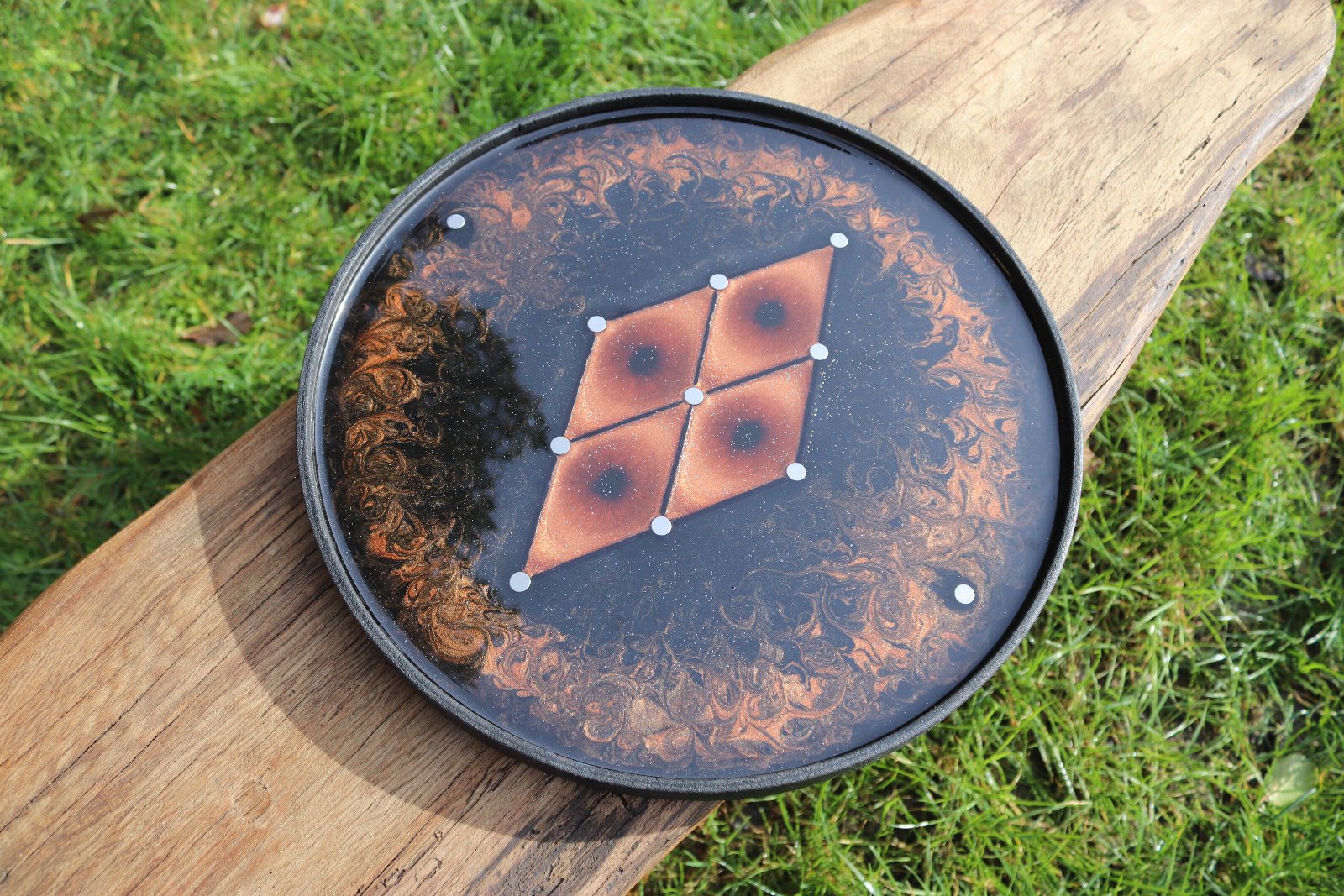
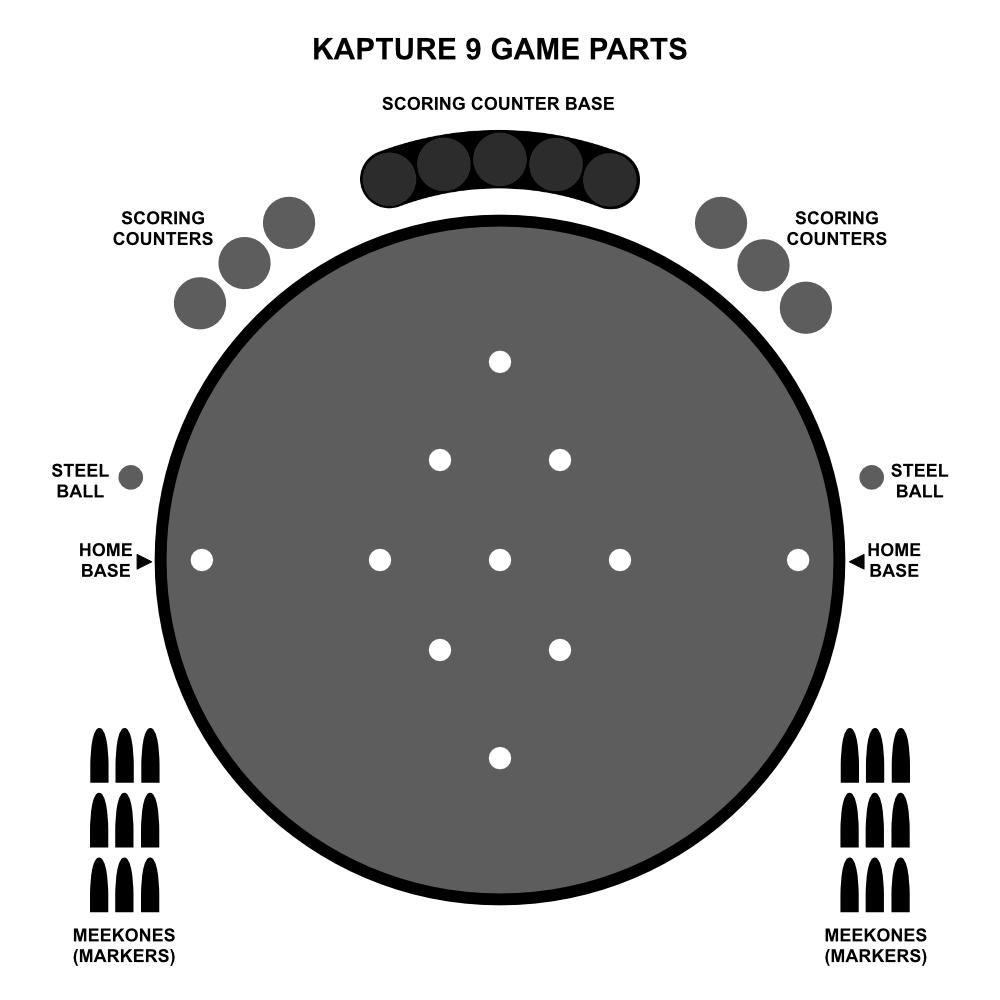
Place the board on a level surface between the two players, so that the single home bases face each player.
There are two sets of pieces and a scoring coin base. Each set includes:
- Nine meekone markers of one colour
- Three score counters of the same colour
- One steel ball
Player 1 takes one set. Player 2 takes the other set.
Place the empty score counter base next to the board.
Both players place a ball on their respective home bases.
It's on.
Play
Play is by turns, in rounds. A round ends when all 9 bases are captured. The first player to win three rounds, wins the game. Keep track of rounds won with the score counters.
Decide which player goes first in the game. After that, the loser of the previous round goes first on the next round.
Player 1 starts by flicking their ball from its home base into the diamond-shaped array of nine bases.
The Flick
Use one finger to flick the ball from the base.
NB: The flick must involve only one point of contact on the ball and one motion. You can use a finger or thumb or similar object, but it must be a single impact motion, no guiding of the ball after it leaves the base. Once the ball has left the base it must not be touched again until it comes to rest.
Several things can happen after the flick. This is the fun part:
Simple base capture
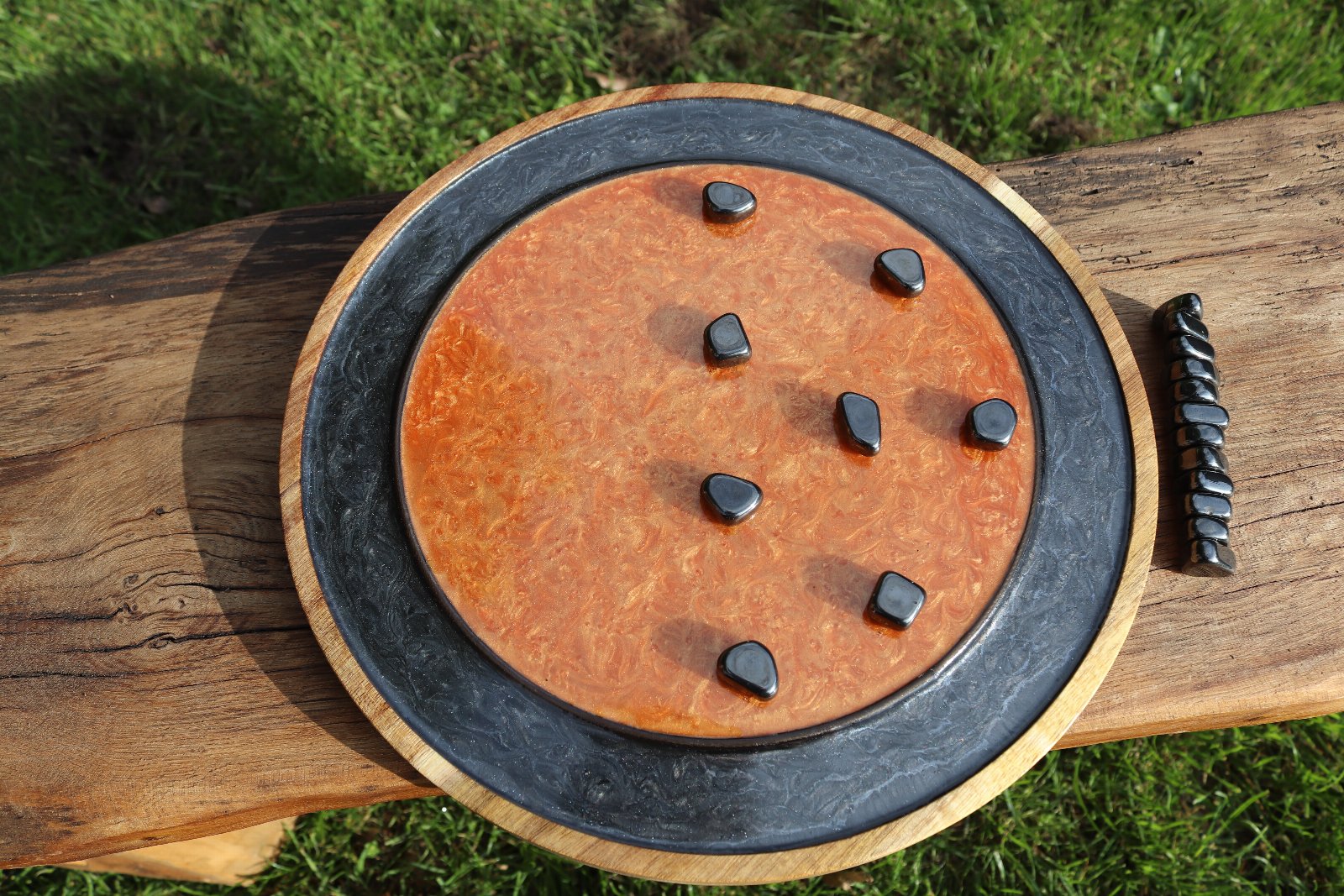
If the ball captures an empty base in the diamond formation, the flicking player replaces the ball with a meekone from their set and returns their ball to their home base. They have captured a base, and now the other player then takes their turn.
Hitting meekones
If the ball knocks a meekone from previously captured base (or multiple meekones from bases), those meekones come off the board to recover and those bases become vacant again.
NB: A meekone is only considered knocked from a base if it is:
- fully removed from the base (i.e. no longer in contact with it at all), or
- knocked over, regardless of whether it is touching its base or not.
If a meekone endures a glancing blow but it stays upright and in even the slimmest contact with the base it was on, it must be replaced fully onto that base as if nothing had happened to it at all.
If the ball knocks off the flicking player's own meekone from a previously captured base (or multiple meekones), those meekones must be removed from the board too. However, if, as often happens, the flicked ball re-captures a base on the same turn, the flicking player gets to put one single meekone back on that re-captured base on the same turn. So for example, you could knock off one of your own meekones but re-capture that base and simply put the meekone back on the base. Or, you knock off two of your own meekones, but re-capture one of the bases or a different base, and you can put one meekone on the captured base, and one comes off the board.
NB: A player will only ever place one meekone on the board in any turn, whether from a freshly captured base, a re-captured base or a free placement from a foul (see Fouls below).
A combination of the above often happens in one turn, with multiple meekones belonging to both players get knocked off, and a base re-captured or maybe not captured or a foul to finish. You will be having a lot of fun at this point and you just have to sort out the carnage. See ‘Edge cases’ below too.
Re-flickable balls
If the flicked ball does not collide with any meekone, does not capture a base and does not foul (see below) and it returns of its own accord to the flicking player's home base, then the flicking player may re-flick that ball from the home base on the same turn. There is no limit to the number of re-flicks if these conditions persist on a turn. An example is a weak flick where the ball barely leaves then returns to the home base. It can be re-flicked.
Dead balls
If the flicked ball does not collide with any meekone, does not capture a base and does not foul (see below) and then comes to rest on some other place on the board, this is a ‘dead ball’. The flicking player gets their ball back, has achieved nothing on this round and now it’s the opponent’s turn.
Fouls
There are two types of foul:
- If the flicked ball is flicked so aggressively that it leaves the board, this is a foul.
- If the flicked ball comes to rest in contact with the opponent’s home base or the opponent's ball sitting on its home base, this is a foul.
If a foul occurs, the flicker gets their ball back and their opponent now has a choice:
- Free placement: A free placement of one meekone on any empty base in the diamond, no flick required
- Flick as normal: Flick the ball as normal to displace opposing meekones (and/or capture a base).
The choice is theirs, and there are strategic reasons why they might decide to flick not pick a base. The most important case is where there is only one remaining base but capturing it would cause the player to lose the round due to having the least captured bases. In this case, you want to flick baby, flick, and knock you off some meekone.
Edge cases
You flick, knock off your own meekone, knock off your opponent’s meekone, then you end up making a foul. Result: any fully knocked off meekones from either side come off the board, and your opponent is awarded a foul.
You flick, knock off your own meekone, but your ball comes back to your home base. Result: your fallen meekone comes off the board, but you don’t get a re-flick. Re-flicks only apply if your ball hit nothing on the way around. Re-captures only apply if your ball captures a base.
You flick, knock off your own meekone(s), but your ball ends up ‘dead’ – no foul, no base captured. Result: Fallen meekone(s) come off the board, and you get nothing more than regret.
Scoring & winning
A round is complete once all nine bases are captured. The player with the most captured bases wins the round and places one of their score counters on the score counter base.
The player who lost the previous round takes the first turn on the next round.
Rounds continue until one of the players has won three rounds, at which point they win the game!